For thousands of years, a man lay hidden beneath the ice of the Alps. No one knew his name, where he had come from, or how he had died. Then, in the summer of 1991, two German tourists hiking in the Ötztal Alps on the border between Austria and Italy noticed what appeared to be a human body trapped in the ice. A few days later, a rescue team managed to free the remains of a bearded man dressed in leather.
At first, there was no reason to think that the discovery was anything more than a remarkable find. But the objects found beside the body soon revealed that the man had lived thousands of years earlier. He had a knife with a flint blade, arrows tipped with flint and, most remarkably, an axe with a copper blade. The man was later given the nickname “Ötzi”, after the Ötztal Alps where he was found.
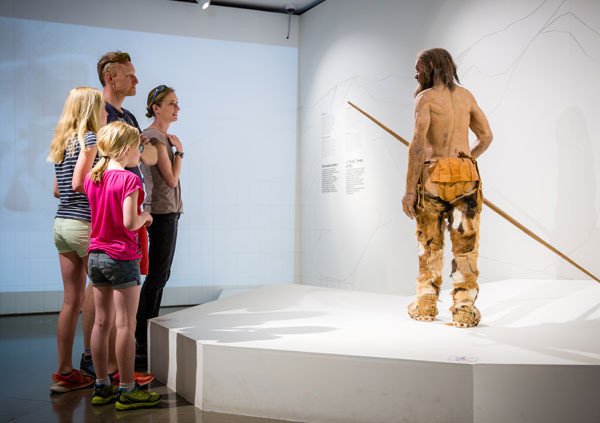
Researchers initially estimated that Ötzi was around 4,000 years old. Later scientific testing showed that he died around 3300 BC, making him approximately 5,300 years old. He lived during the European Copper Age, when people were beginning to use copper while still relying heavily on stone tools.
The discovery was important because a mummy can reveal details about a person’s life that would normally disappear after thousands of years. Ötzi is unusually important because his body was naturally preserved by ice. Most prehistoric human remains have decomposed or survived only as bones, but Ötzi’s frozen body and many of his possessions survived. This gave scientists an exceptional opportunity to study the life of an individual from prehistoric Europe.
Researchers estimate that Ötzi was about 46 years old when he died. Examination of his body has revealed several health problems, including evidence of chronic conditions, parasites, and physical stresses. Some natural substances found among his possessions may have had medicinal uses, although their exact purposes are not always certain.
Scientists have also been able to study the contents of Ötzi’s digestive system. His final meals included meat from animals such as red deer and ibex, as well as einkorn wheat and plant material; older accounts sometimes said chamois, but ibex is the better-supported identification. These remains provide information about his diet and the resources available to people living in the region at the time.
Ötzi’s equipment provides another remarkable window into prehistoric life. He carried a flint knife, bow, arrows, and numerous other tools, as well as a copper axe. The copper axe is particularly significant because it demonstrates that copper technology was being used in the Alpine region around 3300 BC. It supported earlier dating for copper use; however, it did not single-handedly prove the whole Stone-to-metal transition. His possessions also show that stone and metal technologies existed alongside one another rather than one simply replacing the other.
His clothing demonstrates considerable practical knowledge. Ötzi wore carefully constructed shoes and clothing made from animal skins and other materials. He also had a grass cape that could provide protection from wet and cold conditions. His equipment suggests that people of this period were capable of preparing effectively for difficult mountain environments.
His body offered clues about his movements as well. Patterns of stress in the bones of his legs suggested that he regularly travelled through mountainous areas. For a time, scientists thought that Ötzi might have been a shepherd. But later research revealed that his final journey was far more violent than that explanation suggested.
An arrow had been shot into his body, and researchers found evidence that he had also been involved in a physical struggle with other men. The arrow wound caused serious blood loss, while a blow to the head may also have contributed to his death. These discoveries raised the possibility that Ötzi was involved in some kind of conflict. He may have been a warrior or part of a raiding group, although scientists cannot say with certainty who he was or what had brought him into the mountains. Homicide is clear, but his occupation and the exact circumstances are not proven. “Soldier” or “raiding party” is a hypothesis, not an established fact.
That uncertainty is part of what makes Ötzi so fascinating. We do not know his name, his community, or the exact events that led to his death. Yet the ice preserved enough of his body and belongings for scientists to reconstruct fragments of his life more than 5,000 years later.
Ötzi’s story shows how much a single archaeological discovery can tell us about the distant past. His body has revealed what one person ate, the illnesses he suffered from, the tools he carried, and the landscapes he travelled through. What began as a strange body discovered in melting Alpine ice became an extraordinary window into prehistoric Europe.
Sources
Brenda Fowler, Iceman: Uncovering the Life and Times of a Prehistoric Man Found in an Alpine Glacier (New York: Random House, 2000).
S. Bortenschlager, “The Iceman’s Environment,” in The Iceman and His Natural Environment: The Palaeobotanical Results (Vienna: Springer, 2000), 11–24
K. Oeggl, “The Diet of the Iceman,” in The Iceman and His Natural Environment: The Palaeobotanical Results (Vienna: Springer, 2000), 89–115,