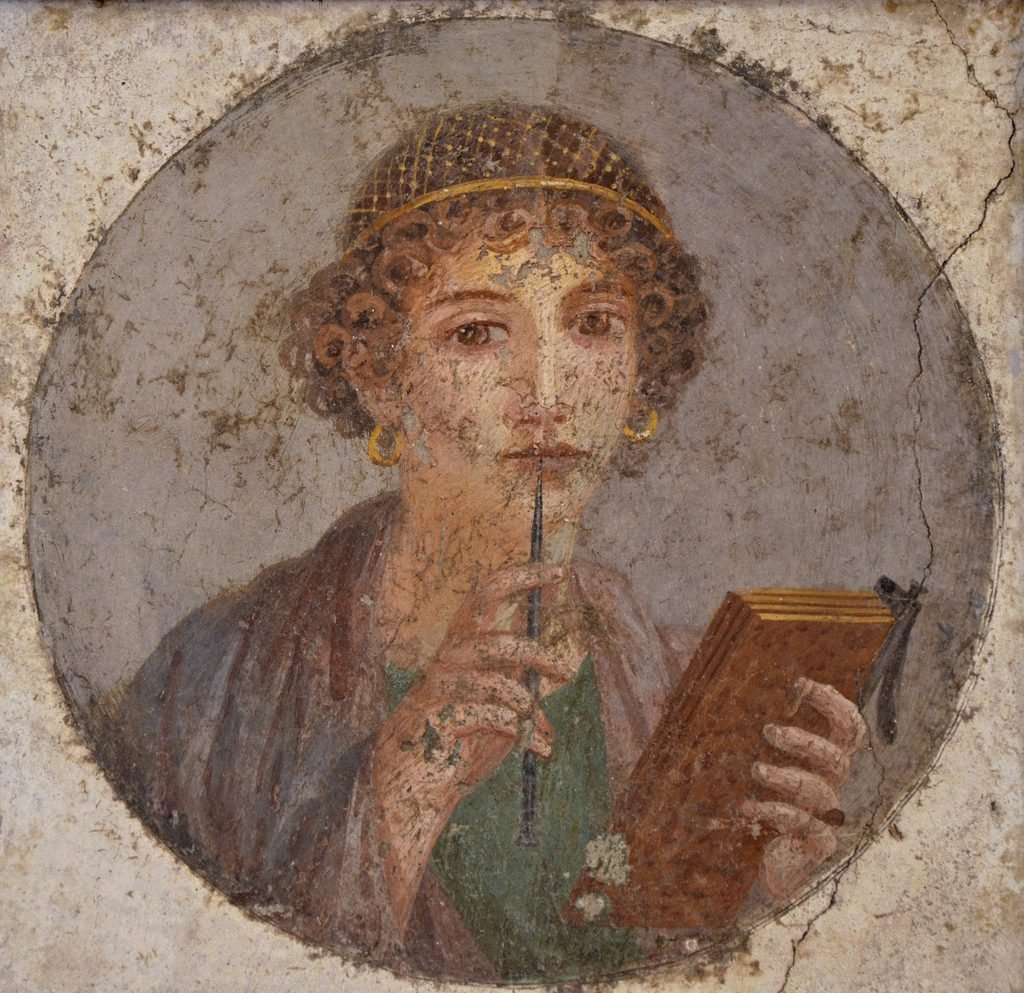
Fig. A scholastic woman with wax tablets and stylus (so-called “Sappho“)
Is a society ruled by men the natural order of things? It is a question that has shaped human history, and one that science is still trying to answer. A look at our closest animal relatives and the lives of ancient peoples suggests the answer is far more complicated—and far more hopeful—than we might think.
Among insects, it is often the females who rule. In ant, bee, and termite colonies, queens dominate, while males are relegated to fertilizing and fighting. Among mammals, the story is usually different. Male chimpanzees, our close evolutionary cousins, are often dominant and can be vicious toward females, engaging in forced copulation, food theft, and even murder. This dark side of chimpanzee behavior has been used to argue that male violence and dominance are deeply rooted in human nature.
But nature is not so simple. The bonobo, another close relative of humans, offers a striking contrast. Bonobo societies are female-dominated, with females cooperating closely and often holding the upper hand. If our family tree contains both chimpanzees and bonobos, then male dominance is not the only possible path.
For most of human history, our ancestors were hunter-gatherers, and in these societies, men and women often lived more equally. Everything changed with the advent of agriculture around 12,000 years ago. As people settled down and began farming, power shifted to physically stronger males. Fathers, sons, and uncles lived near each other, property was passed down the male line, and female independence was eroded. Patriarchy, in this view, is not a biological inevitability but a historical development tied to the rise of farming and private property.
Women, of course, did not always accept this. The legendary Amazons—fierce women archers on horseback—were long dismissed as pure myth. But archaeology tells a different story. Battle-scarred female skeletons buried with their weapons have been found across the Eurasian steppes. These were not figments of the Greek imagination. Warlike nomadic women of the steppes likely inspired tales of the Amazons that spread from Egypt to India and China. Real women fought, hunted, and lived freely.
Even in societies that suppressed women, they were sometimes elevated to divine status. In ancient Mesopotamia, the goddess Ishtar was worshipped as a winged, fully armed warrior who tamed lions and carried spears. She was the Queen of Heaven, a symbol of love, beauty, and victory. Similar goddesses were revered across the ancient world. These images suggest that even in male-dominated cultures, the power and wisdom of women were recognized and feared.
Elsewhere, women held real earthly power. In the Nubian kingdom, ruling queens led their people for centuries. In the Philippines, the Palawan tribe lives with near-perfect equality between men and women. In North-East India, the Khasi people are matrilineal—children take their mother’s name, and the youngest daughter inherits the family land. In south-west China, Musuo women run entire households, and matriarchs govern villages by committee.
History, as they say, is written by the winners—and for most of recorded history, those winners were men. The lives of women in ancient Greece and Rome have often been obscured or ignored. But careful study of poetry, art, coins, and everyday objects is slowly revealing the true richness of their lives: their creativity, their sexuality, their public roles, and their quiet rebellions.
The lesson from both nature and history is clear: male dominance is not a fixed law of nature. It is one pattern among many. Our ancestors lived in diverse ways, and women have always found paths to power, respect, and freedom. If we want a more equal future, it helps to remember that a more equal past was not only possible—it often existed.